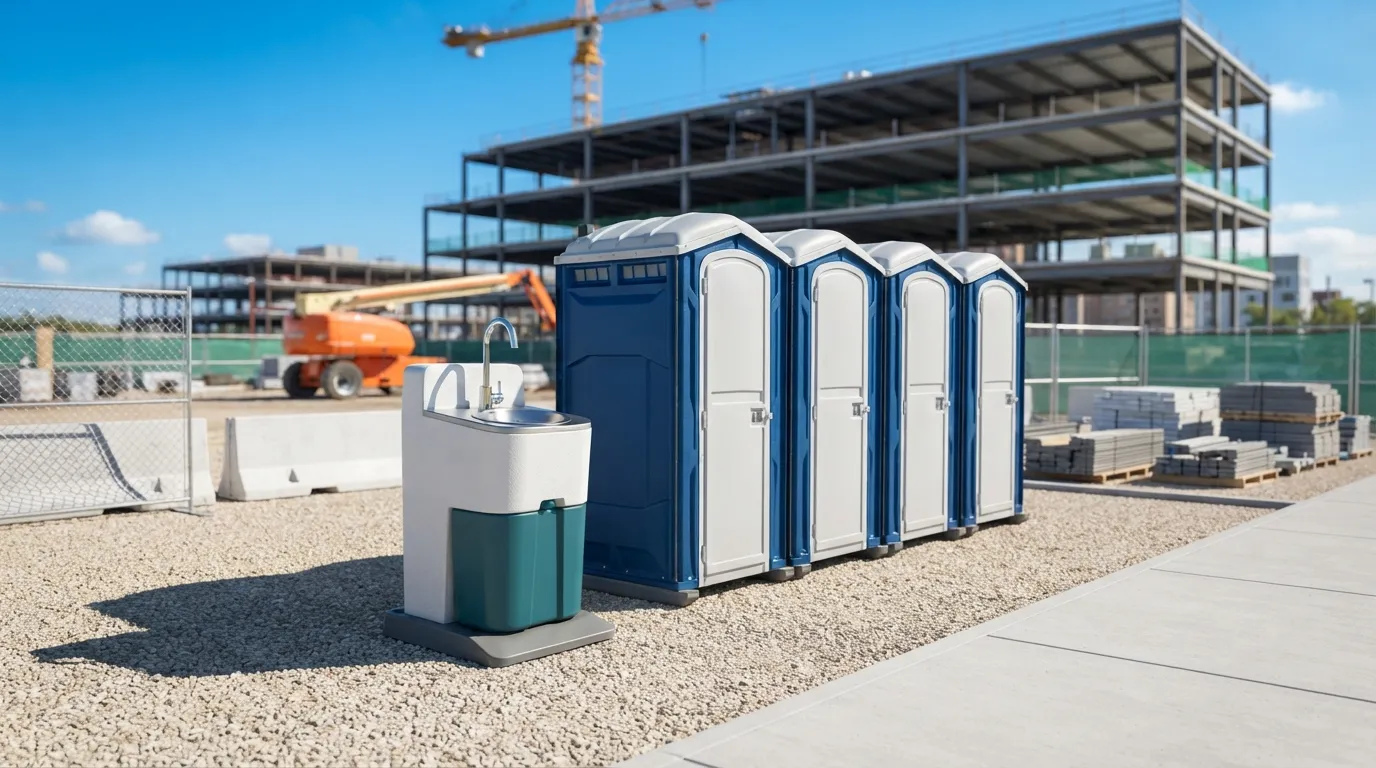
Handwashing stations are required on most Minneapolis construction sites once workers use paints, coatings or similar contaminants, and 29 CFR 1910.141(d)(2) always calls for soap and towels, not sanitizer alone. Minneapolis Porta Pros sets up stations with real running water for job sites, food events and farm crews across the metro.
The rule people quote wrong is 1926.51(f)(1). It only kicks in where employees apply paints, coatings, herbicides or insecticides, or work around other harmful contaminants. It is not a blanket handwashing mandate for every job site. General sanitation and toilet counts fall under OSHA 1926.51(c) instead, which sets facility ratios by crew size. Separately, 29 CFR 1910.141(d)(2) says washing facilities need soap and towels or a hand-drying device. Hand sanitizer, on its own, does not satisfy that rule. Minneapolis crews doing painting, coating or pesticide work should plan for a real handwashing station rental, not just a bottle on a table. Farm operations have their own standard too: OSHA 1928.110 requires potable water, toilets and handwashing for hand-labor employees, at one facility per 20 workers, reachable within a quarter mile walk. That distance matters for crews spread across a field near Minneapolis, where walking back to a single station eats into paid time.
Yes, if you are serving or prepping food in Minneapolis, plan on a dedicated handwashing setup separate from your restroom units. Event organizers running a festival, concert or county fair often pair a portable sink rental with their event restroom rental order so food vendors are not sharing water basins with guests. A hand sanitizer station rental is a fine supplement near entrances or high-traffic pinch points, but it does not replace soap-and-water washing under 29 CFR 1910.141(d)(2) if food handling is involved. Weddings and smaller private events in Minneapolis usually get by with one or two stations near the wedding restroom rental setup, placed close enough that guests actually use them. For anything with a bar, a grill, or a catering tent, budget for more.
Match your station count to your worker or guest count, not your gut feeling. OSHA 1926.51(c) sets the ratio for toilets at 1 per 20 workers up to 20, then 1 toilet seat and 1 urinal per 40 workers as crews grow past that, and 1 per 50 once you hit 200 or more. Handwashing stations should scale alongside that ratio on a construction site. ANSI/PSAI Z4.3 sets a baseline service interval of once per week for up to 10 users over a 40 hour week, which is a decent planning number for how often a station needs restocking and pumping, not just cleaning. A crew of 35 working a renovation near St. Louis Park, 8.0 miles west of Minneapolis, needs more than one station tucked in a far corner. Use the how many porta potties do I need guide to size out your full restroom count too, since stations and toilets usually get ordered together.
Placement rules trace back to accessibility more than anything else. ADA Standards section 403.5.1 requires a 36 inch clear path to any accessible unit, and section 404.2.3 sets minimum door opening width at 32 inches, both worth checking before you drop a station behind a stack of materials. Where portable toilets are clustered, ADA Standards section 213.2 requires at least 5 percent of units to be accessible, with never fewer than one, and that same clustering logic applies to handwashing stations placed alongside them. Ground needs to be firm and stable under ADA Standards section 302.1, which rules out soft turf or loose gravel as a base. For jobs in Minneapolis proper, or in nearby Richfield 8.1 miles south, check the porta potty placement guide before finalizing a layout, and confirm with the city if you are placing anything in the public right of way, since that rule was not verified for this page. A porta potty permit requirements check is worth doing early, not the week before delivery.
Stations for winter jobs need extra thought too. Freezing lines and tanks change how often service visits happen, and the porta potty in winter page covers what changes when temperatures drop. If your site also needs temporary fence rental or a light tower rental, coordinate delivery so the crew dropping stations is not blocked by fencing already staged. Renovation crews working closer to Roseville, 9.0 miles northeast, often bundle a handwashing station with a construction dumpster rental order to get one delivery instead of two truck visits.
Pricing depends on unit type, how long you need it and whether it is bundled with toilets. Check porta potty rental cost for baseline restroom pricing, since stations are usually quoted alongside a standard or deluxe unit order rather than as a standalone line item.
No. 29 CFR 1910.141(d)(2) requires soap and towels or a hand-drying device at washing facilities. Sanitizer is a fine supplement near entrances, but it does not replace running water and soap where the rule applies.
Often yes, especially for food service or painting work. A deluxe flushable porta potty has its own sink, but larger crews or vendor rows still need dedicated stations sized to headcount.
They overlap. A portable sink rental typically has a larger basin and is aimed at food prep, while a handwashing station is built for quick crew turnover on a job site. Both need soap and towels under federal rules.
Yes. Farms, food trucks and small crews rent stations alone all the time. Larger construction sites in Minneapolis usually order them together since delivery and service routes overlap anyway.
Yes. Minneapolis Porta Pros delivers handwashing station requirements across Minneapolis and the surrounding metro, with same-day and next-day drop-off available on most orders.
Pricing depends on the unit and how long you need it. See our cost breakdown and request a free quote for an exact figure.
Standard rentals include scheduled service — a pump-out, a clean, a restock and fresh deodorizer. Busy or hot-weather sites can be serviced more often.
Call now or request a free quote — clean units, on-time delivery, transparent pricing.