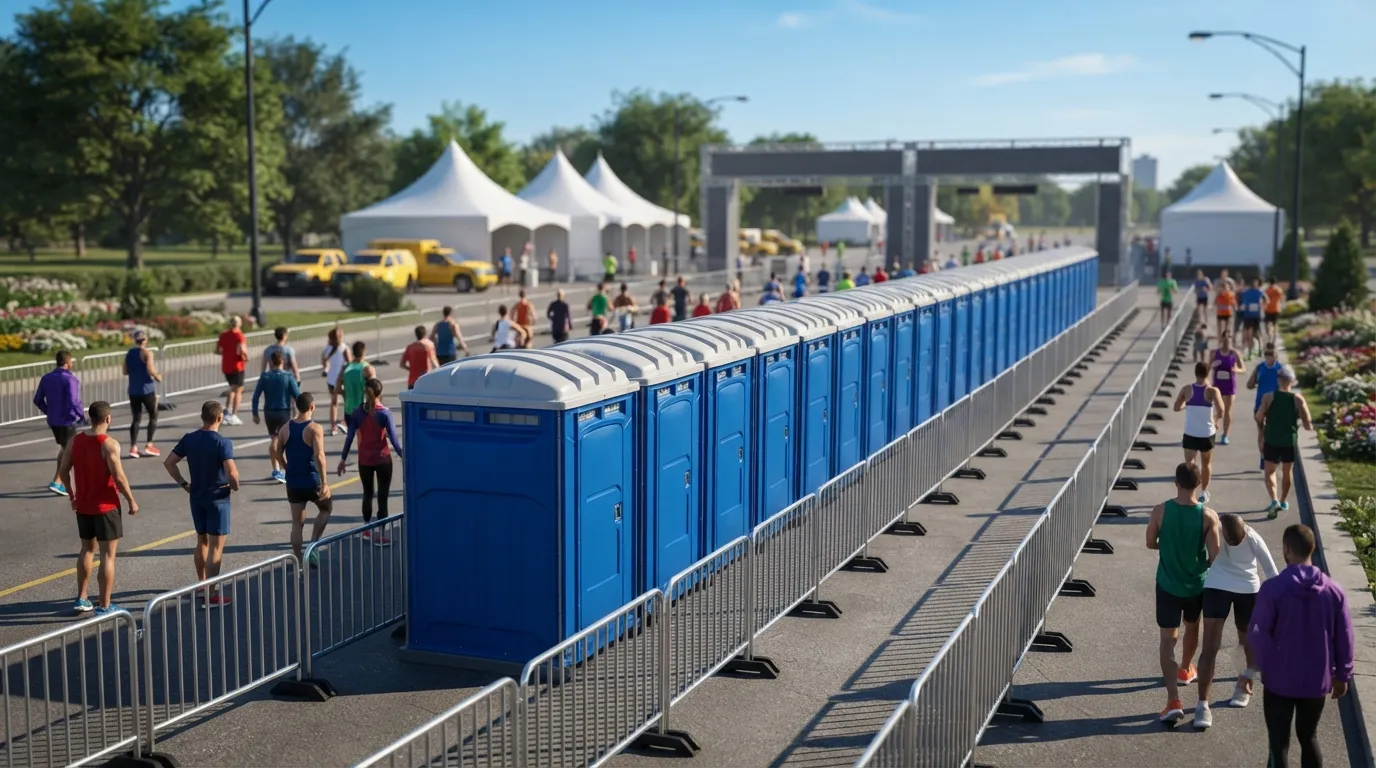
A marathon course through Minneapolis needs restrooms staged roughly every 1 to 2 miles along the route, plus a bank of units at start and finish corrals. Most race organizers run standard portable toilets at aid stations and add ADA units at every major gathering point. Budget around $200 to $400 per unit for event-length rentals.
Runners cluster hard at the start line, thin out on course, then pack back in at the finish. That means your restroom count is not one flat number, it is three different problems. At the start corral, plan for the biggest crowd of the day, since most of your field will use a restroom in the twenty minutes before the gun. How Many Porta Potties Do I Need walks through the math by headcount, and it is worth running before you call anyone.
On course, spacing matters more than raw count. Aid stations every 1 to 2 miles are the natural spot to drop a unit or two, since runners already expect a stop there. Standard Porta Potty Rental covers what a basic unit includes, and pricing for race-day use runs in the standard event band from around $200 to $800 depending on cluster size and duration. At the finish, expect a second wave of demand as finishers linger, and that is where a lot of races under-plan. Minneapolis races that loop through multiple neighborhoods often need units staged at each aid station location, not just clustered near downtown.
Accessibility is not optional at any of these points. ADA Standards section 213.2 requires that where single-user units are clustered, at least 5 percent be accessible, with a minimum of one unit no matter how small the cluster. That rule applies at your start line, your finish line, and any aid station big enough to warrant more than one unit. ADA Accessible Porta Potty has the specs, and ADA Standards section 405.2 also caps ramp slope at 1:12 wherever you place a ramped unit on uneven turf.
A pre-dawn start means lights before sunrise, and a finish line festival often runs past dark. Both call for equipment most race directors do not think about until the week before. Light Tower Rental covers the fixtures themselves, but the harder question is often power. If your timing tent, sound system, and finish arch all draw from one source, you need a real electrical plan, not a string of extension cords across a Minneapolis park path.
That is where a temporary power pole comes in. Temporary Power Pole explains setups that typically run on 200 amp service, enough to cover timing equipment, lighting, and vendor tents without tripping breakers mid-race. How to brace a temporary power pole matters more than most organizers expect: the pole needs a stable base and guy-wire bracing so wind or a jostled cable does not pull it over during a crowded event. Loose bracing is one of the more common site failures on outdoor race courses, especially on grass or gravel where a post cannot be sunk deep.
Pair power with fencing at anything resembling a finish chute. Temporary Fence Rental and Crowd Control Barrier Rental both fall in the day rate band of roughly $30 to $75 per section, and OSHA 1926.202 requires that barricades protecting workers conform to ANSI D6.1, a standard worth mentioning to any timing crew or medical tent staff working your event. If your race also uses a dumpster for cup and gel wrapper cleanup at aid stations, Roll-Off Dumpster Rental and Dumpster Sizes and Dimensions cover what fits behind a finish line tent without blocking the course.
Most races mix standard units on course with a denser cluster at start and finish, and add a trailer if the event has a VIP or sponsor tent. Restroom Trailer Rental and 2 Stall Restroom Trailer work well for smaller sponsor areas, while 4 Stall Restroom Trailer or 8 Stall Restroom Trailer options handle bigger finish festivals with beer gardens or expo booths. Trailer rentals for single-day events run in the range of roughly $175 to $2,500 depending on size and stall count, and multi-day races push into the weekend and week bands.
Handwashing matters just as much as toilet count. OSHA 1926.51(c) sets toilet ratios by worker headcount on construction sites, but race organizers should still think in the same terms: more units per thousand runners, not fewer. Handwashing Station Requirements and Handwashing Station Rental cover setups that pair with restroom clusters at aid stations, and 29 CFR 1910.141(d)(2) is a useful reference point since it requires soap and towels, not sanitizer alone, at any staffed facility. If your race runs through neighborhoods near St. Louis Park, 8.0 miles west of downtown Minneapolis, or loops toward Roseville, 9.0 miles northeast, factor drive time into your delivery schedule with Emergency Porta Potty Rental as a backup option if a unit needs mid-event servicing. For general race and course planning, Marathon and Race Restrooms is the hub page tying all of this together, and Event Restroom Rental covers broader event logistics beyond race day specifically.
Book 60 to 90 days out for anything over a few hundred runners, since trailer and ADA unit availability tightens closer to race weekend. Smaller local races can often book 2 to 3 weeks out. Confirm your headcount early using How Many Porta Potties Do I Need.
Yes, if any single-user cluster exists there. ADA Standards section 213.2 requires at least one accessible unit per cluster, even a small one. See ADA Restroom Requirements for full placement guidance.
It depends on expected trash volume, but 10 Yard Dumpster Rental covers most single-day race finishes. Larger multi-day festivals may need 20 Yard Dumpster Rental instead.
Yes. Emergency Porta Potty Rental covers same-day service calls, useful for aid stations that see heavier use than expected on race day.
That depends on placement and load, and it is not something to guess at. Confirm requirements directly with the city before race day, and pair your setup with Temporary Power Pole guidance on bracing and service size.
Yes. Minneapolis Porta Pros delivers marathon and race restrooms across Minneapolis and the surrounding metro, with same-day and next-day drop-off available on most orders.
Pricing depends on the unit and how long you need it. See our cost breakdown and request a free quote for an exact figure.
Standard rentals include scheduled service — a pump-out, a clean, a restock and fresh deodorizer. Busy or hot-weather sites can be serviced more often.
Call now or request a free quote — clean units, on-time delivery, transparent pricing.